8 best website change monitoring tools in 2026
An honest comparison of website change monitoring tools: Visualping, changedetection.io, Distill, Hexowatch, Wachete, ChangeTower and more. Who each is for.
 Alexandra SwanCustomer Operations Lead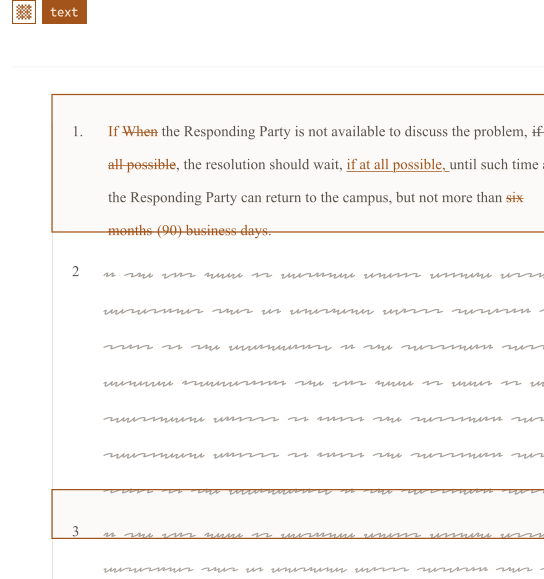
The short answer
The right website change monitoring tool depends on one question: are you monitoring a page for yourself, or monitoring pages your work depends on? For self-hosting and full control, changedetection.io is the strongest option and it is free and open source. For polished visual monitoring with screenshot comparisons, Visualping is the most established. For deep technical control over what counts as a change, Distill is the usual choice. Website Change Tracker, our own tool, is built for people who want a managed monitor with plain-English rules and no maintenance.
A note on who wrote this
Website Change Tracker is our product. It is on this list, and you should read what we say about it with that in mind.
We have written the rest of this honestly, because there is no point doing otherwise. Every tool below is a reasonable choice for somebody, several of them are better than ours at specific jobs, and we say so where it is true. If a round-up tells you the author's own product wins every category, close the tab.
Personal or operational: the question that picks the tool
Almost everyone choosing a monitoring tool is answering one of two very different questions, and the answer points to different tools.
The first is personal: you want to know when a price drops, when a product is back in stock, when a role is posted. You are monitoring a handful of pages, nobody else needs to see the alert, and if the monitor breaks for a day the cost is that you missed a sale.
The second is operational: you are monitoring pages your work depends on, such as a competitor's pricing, a regulator's guidance, a supplier's terms, or your own site. Several people need to see the alert. If the monitor breaks quietly, you find out when someone asks why nobody flagged the change three weeks ago.
Tools that are excellent for the first question are often a poor fit for the second, and the reverse. Work out which one you are before you compare features.
The tools, and who each one is for
This list is not ranked. Ranking tools that solve different problems is how you end up with a round-up that helps nobody.
changedetection.io: the best free option, if you will run it
Open source, self-hosted, and genuinely free. You can watch as many pages as your server will handle, you own the data, and you can extend it as far as your patience goes. For a technical user who already runs a server, it is very hard to beat on value.
The cost is not money, it is attention. You are running the monitor, which means you are also monitoring the monitor: keeping the container up, handling upgrades, and noticing when it has quietly stopped. That is fine if you enjoy it and a genuine liability if you do not.
Best for: technical users who want full control, will self-host, and are comfortable maintaining it.
Visualping: the most established, and the strongest at visual diffs
The best known tool in the category, and the one most people find first. Its core strength is visual monitoring: it takes screenshots and shows you a before-and-after comparison with the changed region highlighted, which is the clearest possible way to see that a layout, an image, or a banner has changed. It also offers AI summaries of what changed, and a browser extension for starting a watch from the page you are on.
If your changes are visual rather than textual, or you want the most polished and proven product in the category, this is the default choice and we will not pretend otherwise.
Best for: visual change detection, teams who want the established option, and anyone who wants a browser extension.
Distill: the most technical control
Distill is the usual answer for people who found the mainstream tools too blunt. It gives you finer control over selecting exactly what on a page counts as a change, and it can run checks locally in your browser as well as in the cloud, which matters for pages that behave differently when fetched by a server.
The trade-off is that the control has to be exercised. It rewards a user who is willing to learn its model and punishes one who wants to paste a URL and walk away.
Best for: users who want precise control over what triggers an alert, including local checks.
Hexowatch: the widest range of monitoring types
Hexowatch's pitch is breadth. Rather than one kind of monitoring, it offers many different modes, covering visual, content, source code, technology, availability and more. If your requirement is a long and varied list, it covers more of it in one place than most.
Breadth has a cost in focus. A tool with a dozen monitoring modes has a dozen things to understand before you set up the first one.
Best for: users with a varied list of monitoring needs who want them in one product.
ChangeTower: archiving and history
ChangeTower leans into keeping a full archive of what a page looked like over time, rather than only telling you that it moved. If your requirement is less 'alert me' and more 'be able to prove what this page said in March', that emphasis matters.
Best for: teams whose real need is a durable archive, not just an alert.
Wachete and the budget tier
There is a group of tools, Wachete among them, competing mainly on being inexpensive for a decent number of pages. If you need to watch many pages, none of them urgently, and the budget is the binding constraint, this is the tier to look at.
Best for: watching a lot of pages cheaply, where none of them are time-critical.
UptimeRobot and the uptime tools
Several uptime monitoring products have added content change detection alongside their core job of telling you when a site goes down. If you are already paying one of them to watch your infrastructure, check what it does before you buy a second tool. The change detection is usually less sophisticated than a dedicated product, but 'already in your stack' is a real advantage.
Best for: teams who already run uptime monitoring and have modest change-detection needs.
Website Change Tracker: managed, with plain-English rules
Ours. It is a managed cloud monitor, so there is nothing to host and nothing to maintain. You paste a URL, describe the change worth waking you up for in plain English rather than picking a selector, and choose where the alert lands. Changes are marked inline, showing what was removed and what replaced it, and every check is saved with a timestamp so you can show what a page said on a given date.
Being straight with you: it is a young product. It does not have Visualping's track record, it does not have changedetection.io's extensibility, and there is no browser extension today. If those are what you need, take one of those instead. What it is built for is the person who wants a monitor that works without becoming a project.
Best for: people who want a managed monitor with no setup and no maintenance.
Website change monitoring tools compared
Pricing is deliberately absent. Every tool here changes its plans, and a table of prices that is wrong within a quarter is worse than no table. Check the current pricing page of anything you shortlist.
| Tool | Hosting | Strongest at | Weakest at |
|---|---|---|---|
| changedetection.io | Self-hosted | Cost, control, extensibility | You maintain it |
| Visualping | Cloud | Visual diffs, maturity, extension | Cost at higher volumes |
| Distill | Cloud and local | Precise control over triggers | Learning curve |
| Hexowatch | Cloud | Breadth of monitoring types | Focus |
| ChangeTower | Cloud | Archiving and page history | Narrower feature set |
| Wachete | Cloud | Watching many pages cheaply | Time-critical checks |
| Website Change Tracker | Cloud | Zero setup, plain-English rules | Young product, no extension |
How to choose a website change monitoring tool
Ignore feature lists for a moment and answer these in order. The answers will eliminate most of the list quickly.
- Will you self-host? If yes and you are technical, use changedetection.io and stop reading. It is free and it is good.
- Is the change visual or textual? Screenshot comparison matters enormously for layout and imagery, and barely at all for a price or a version number.
- Who needs to see the alert? If the answer is a team, you need shared channels and a shared view of what is being watched, which rules out the single-user tools.
- Do you need to prove what a page said later? If yes, the archive matters more than the alert, and you should weight history and snapshots heavily.
- How much maintenance are you willing to own? This is the question people answer optimistically and regret. Be honest.
Every tool on this list can be evaluated without paying up front, most on a free tier and ours on a 14-day trial. The fastest way to decide is to put the same page into two of them and see which alert you would actually act on.