MAP monitoring: how brands catch minimum advertised price violations
MAP monitoring explained: what counts as a violation, how to enforce a MAP policy within US law, and 11 MAP monitoring tools compared, from $49 a month.
 Alexandra SwanCustomer Operations Lead
The short answer
MAP monitoring is tracking the prices resellers advertise online against a brand's minimum advertised price (MAP). MAP monitoring software checks Amazon, Walmart, Google Shopping and dealer websites, saves timestamped evidence and sends notices. In a 2016 Marketing Science study of 1.25 million daily online prices, unauthorized sellers advertised below MAP up to 50% of the time.
What is MAP monitoring?
MAP monitoring is how a brand checks that resellers advertise its products at or above the minimum advertised price it has set, and keeps proof of any that don't. It covers the advertised price only: as the law firm GGB Law puts it, 'MAP controls advertised prices only, not resale prices'. Three pricing terms get mixed up:
| Term | What it means | Who sets the selling price |
|---|---|---|
| Minimum advertised price (MAP) | The lowest price a reseller may advertise, online or in print | The reseller; only the advertised price is limited |
| Manufacturer's suggested retail price (MSRP) | A suggested price with no obligation attached | The reseller, freely |
| Resale price maintenance (RPM) | An agreement on the price a reseller actually sells at | The supplier, with the reseller's agreement; judged case by case under federal law, illegal outright in some states |
MAP pricing compliance means that resellers' advertised prices meet the brand's policy. Monitoring it means checking the places the policy covers, such as websites, marketplace listings, comparison shopping feeds and printed ads, often enough to catch a below-MAP price while it is still live. For tracking a single price on any page, see how to track price changes on any website.
What is a MAP policy?
A MAP policy is a brand's written rule setting the lowest price at which resellers may advertise its products, and the consequences for advertising below it. Many are written as one-sided policies rather than contracts. PDI's MAP policy, for example, states that 'This Policy is not an agreement', and says sellers 'remain free to advertise and sell all of our products (including the Covered Products) at any price', with the brand free to stop supplying them.
A typical MAP policy says which channels count as advertising, how cart prices, coupons and bundles are treated, whether in-store ads are included, and when MAP holidays apply. LuminAID's policy, for example, says 'This policy does not apply to in-store advertising' and lists its MAP holiday dates.
Is MAP pricing legal?
In the US, a MAP policy is generally legal when the brand sets it on its own and simply stops supplying resellers who ignore it. United States v. Colgate (1919) recognized a seller's right to 'announce in advance the circumstances under which he will refuse to sell'. The Federal Trade Commission (FTC) puts it this way: 'If a manufacturer, on its own, adopts a policy regarding a desired level of prices, the law allows the manufacturer to deal only with retailers who agree to that policy.' It adds: 'A manufacturer also may stop dealing with a retailer that does not follow its resale price policy.' Going along with a policy is not the same as promising to: in Monsanto v. Spray-Rite (1984), the Supreme Court said 'a distributor is free to acquiesce in the manufacturer's demand in order to avoid termination.'
Leegin v. PSKS (2007) held that 'vertical price restraints are to be judged by the rule of reason', case by case, so even an agreed minimum resale price is not illegal outright under federal law. United States v. Parke, Davis (1960) marks the limit of the one-sided approach: a manufacturer that secures adherence to its prices by means beyond simply refusing to deal becomes, in the Court's words, 'the organizer of a price-maintenance combination or conspiracy'.
States can be stricter. The FTC notes that 'some state antitrust laws and international authorities view minimum price rules as illegal, per se', and since 2009 Maryland law has treated a contract setting a minimum resale price as an unreasonable restraint of trade.
MAP programs can also go too far. In 2000, the five largest distributors of recorded music settled FTC charges over MAP policies that covered even in-store signs and ads retailers paid for themselves, and could cost a retailer its cooperative advertising funds for all its stores for up to 90 days after one violation. The FTC said consumers 'may have paid as much as $480 million more than they should have' for CDs over three years.
This is general information, not legal advice. How a MAP policy is worded and enforced decides whether it stays one-sided, so have a lawyer review yours.
What counts as a MAP violation?
A MAP violation is an advertised price below the brand's MAP in any channel the brand's policy covers, such as 'a website, marketplace listing, comparison shopping feed, or printed circular', as Competera lists them. The selling price itself is not a violation. The most common MAP policy violations are:
- Below-MAP listings on marketplaces and dealer sites, often set by repricing software acting without reference to the brand's policy, as Competera notes.
- Cart-only prices, shown with wording such as 'see price in cart' or 'add to cart for price', where the policy bans them. PDI's policy bans these; other policies allow them.
- Coupon and promotional codes that take the advertised price below MAP, where the policy bans them. LuminAID allows product-specific coupon codes; PDI bans promotional codes that do this.
- Bundles and multipacks priced below the combined MAP of their items.
- Comparison shopping listings, such as Google Shopping, showing a price below MAP.
Google Merchant Center has its own rule for this. Merchants who sell a product for less than the price allowed by third-party agreements should 'Submit the minimum advertised pricing (MAP) value as the "price"' in their product data. They may show a note such as 'Add to cart for final price' on the landing page, but not 'View price in cart'.
On 11 October 2026, Academy Sports + Outdoors' own site showed 'Our Price In Cart' instead of a price for some YETI items. That is cart pricing, not necessarily a violation: YETI's own policy, which we have not seen, decides.
How common are MAP violations?
MAP violations are common, and far more common among sellers the brand never authorized. In a 2016 Marketing Science study by Israeli, Anderson and Coughlan of over 1.25 million daily online prices from about 1,000 retailers, unauthorized retailers advertised prices below MAP as much as 50% of the time, against about 20% for authorized retailers.
In a September 2026 analysis by GrowByData, which sells MAP monitoring, of 617,958 reseller and product observations for six brands between January 2024 and August 2026, Google Shopping accounted for 80% of recorded violations. Violation rates were 33.3% on Google Shopping, 20.9% on Amazon and 10.0% on Walmart, and in GrowByData's data the worst 10% of reseller and brand combinations produced 86% of violations.
Enforcement pays off. A 2018 Marketing Science study by Ayelet Israeli found that a manufacturer's new enforcement policies led to 'substantially fewer violations', and that 'channel prices increase by 2% without loss in volume.'
How to enforce a MAP policy
Enforcing a MAP policy means writing it as a one-sided policy, monitoring the channels it covers, and applying the same consequences to every reseller who breaks it. This is common practice, not legal advice: have a lawyer approve the policy and the notice template. A typical sequence:
- Write the policy as a policy, not an agreement. Say which channels count as advertising, how cart prices, coupons and bundles are treated, and whether in-store ads are included.
- Monitor every channel the policy covers, on a schedule, and keep timestamped evidence: the page address, the advertised price and a screenshot.
- Send a written notice for a first violation, with the evidence.
- Escalate the same way every time. PDI's published ladder runs from a written notice, to a notice with a 14-day shipping hold, to 'Termination of business relationship and revocation of "authorized" status.'
- Decide alone. Do not ask retailers for input on enforcement, and do not ask a reseller to promise it will comply; under Parke, Davis (1960), securing adherence beyond a refusal to deal can turn a policy into an agreement.
- Announce any MAP holidays, the windows when the brand relaxes MAP for a promotion, in advance and to all resellers.
A MAP policy only has force with resellers the brand supplies, because its consequences, from shipping holds to being cut off, only reach them; the law firm Vorys notes that 'MAP policies are not binding on unauthorized retailers.' For unauthorized sellers, one approach is to trace which authorized distributor supplied them, for example with a test purchase, and enforce your distribution agreement if it limits whom the distributor may sell to. Act on whom it sold to, not on the reseller's price: in Parke, Davis, using wholesalers to cut off price-cutting retailers is what the Court held created a combination.
Marketplaces act only on intellectual property (IP) claims, and reselling genuine goods is generally not trademark infringement, so file one only with a real basis, such as counterfeits, and with a lawyer. For counterfeit listings, see trademark monitoring.
Do Amazon and Walmart enforce MAP?
No. Amazon says enforcing distribution agreements is not its role, and Walmart Marketplace's published pricing and Brand Portal rules do not cover MAP. Amazon's policy, as quoted by the American Intellectual Property Law Association, says that violations of a manufacturer's exclusive distribution agreements 'do not constitute intellectual property rights infringement' and that 'it would not be appropriate for Amazon to assist in enforcement activities.' Amazon's Report a Violation tool covers IP infringement, store policy and regulatory concerns, and does not mention pricing.
Walmart Marketplace's pricing rule unpublishes offers 'priced egregiously higher' than they should be, and its Brand Portal takes claims of copyright, trademark, patent and counterfeit. Google Shopping has a MAP rule, but it governs how merchants submit prices, not enforcement for brands.
MAP monitoring software compared
As of 11 October 2026, MAP monitoring software runs from $49 a month (MapAuthority) to $999, and Wayvia, TrackStreet, Intelligence Node and Wiser quote on request. These tools check listings across marketplaces and retailer sites, match them to your products and sellers, and document violations. From each vendor's own pages, plus news reports for Wiser and Wayvia:
| Tool | What it monitors | How often | Price |
|---|---|---|---|
| Frigginyeah | 200+ retailers and marketplaces, with timestamped captures and escalating notices up to a certified-mail cease-and-desist | Daily; 1 to 4 times a day on Lite | From $129 a month (Amazon, up to 100 listings); $659 a month for 4 sites and 200 products each |
| MapAuthority | Amazon first; all marketplaces and retail sites from its Commander tier | Not stated | $49 a month for 50 Amazon products; $249 with automated violation emails; $499 all channels; $999 top tier |
| Pricefy | Amazon, eBay, Google Shopping and price comparison sites | Daily | MAP monitoring from the Business plan, $189 a month or $142 billed yearly |
| Prisync | MAP monitoring for suppliers | Not stated for MAP | Platinum plan only, $399 to $799 a month |
| Price2Spy | MAP monitoring from its Basic tier; screenshots as an add-on | Up to 8 times a day on Premium | Its own pages quote $78.95 and $157.95 a month as the entry price |
| MetricsCart | MAP and price monitoring | Not stated | From $300 a month |
| Wayvia Prowl (formerly PriceSpider) | 20+ marketplaces including Amazon and Walmart; adds items to carts; screenshots as evidence | 8 times a day at unpredictable times, it says | On request |
| TrackStreet | 185,000+ websites and marketplaces, it says, with notice workflows | Not stated | On request |
| Trade Vitality | Amazon, Walmart, eBay, Google Shopping and dealer websites | Daily | Not published |
| Intelligence Node | Screenshots as proof of violation; an Omnicom company, per its site | As often as every 10 seconds, it says | On request |
| Wiser | MAP execution across websites, with strike notices; filed for Chapter 11 in April 2026 and sold substantially all its assets to an affiliate of Crestline Direct Finance in July 2026 | Within hours of a price drop, it says | On request |
Choose by where your products sell. Amazon-heavy brands can start with an Amazon-focused tool; brands sold through many dealers and Google Shopping need wide coverage and screenshots. Ask every vendor whether it can see cart-only prices, coupons and member prices, since coverage of these varies by tool, and whether its evidence holds up when a reseller disputes a notice. For your own competitive pricing, see competitor price monitoring.
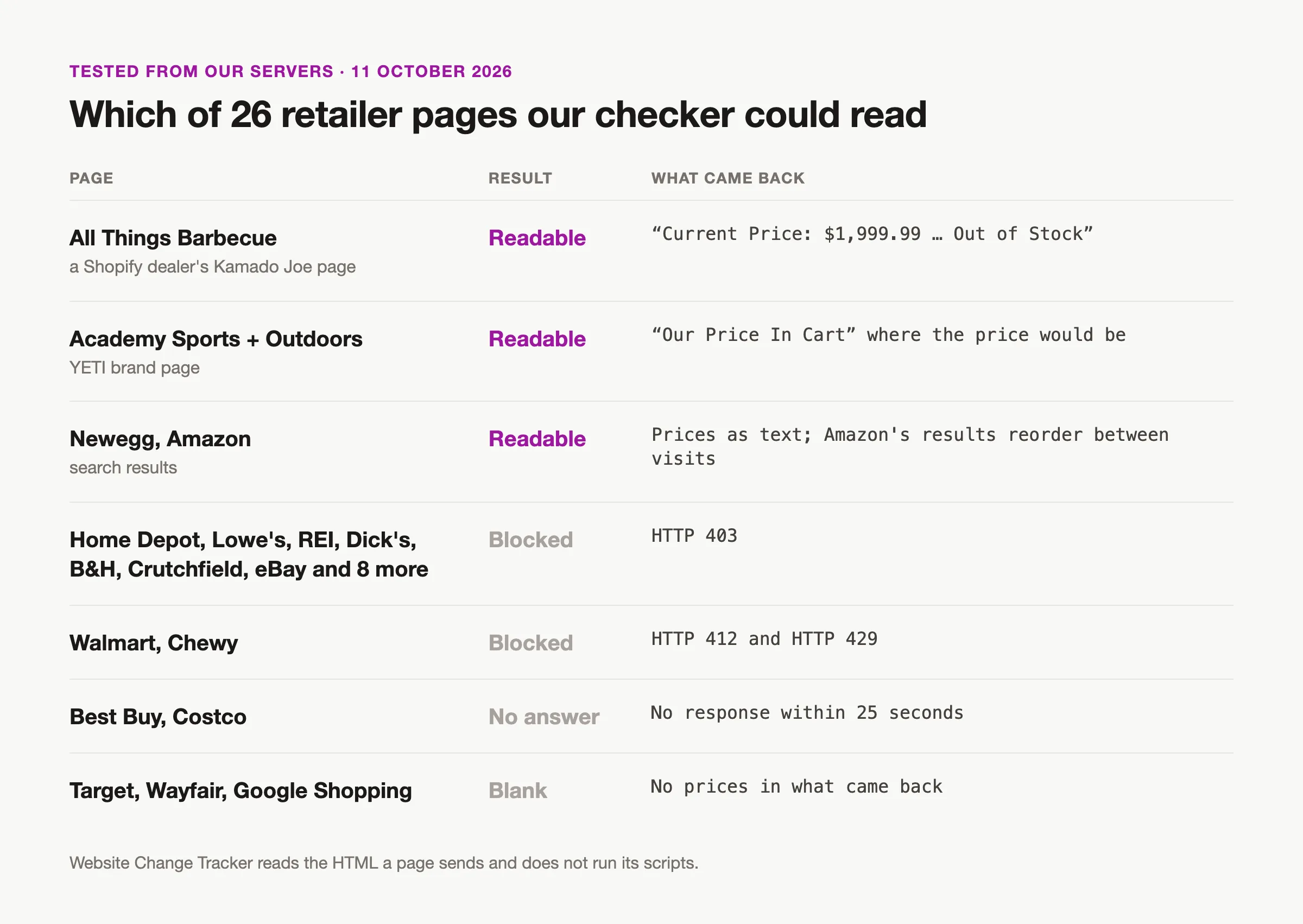
Which retailer pages Website Change Tracker can read
Four of 26: when Website Change Tracker's checker tried 26 retailer and marketplace sites on 11 October 2026, 15 refused the request outright and four returned prices it could read:
| Result | Sites |
|---|---|
| Readable, with prices | All Things Barbecue (a Shopify dealer), Academy Sports + Outdoors, Newegg search, Amazon search (its results reorder between visits) |
| Refused (HTTP 403) | Home Depot, Lowe's, REI, Dick's, Backcountry, Scheels, Crutchfield, B&H Photo, Sweetwater, Ace Hardware, Bass Pro, Northern Tool, Zoro, BBQGuys, eBay |
| Refused another way | Walmart (HTTP 412), Chewy (HTTP 429, too many requests) |
| No answer within 25 seconds | Best Buy, Costco |
| Answered without prices | Target (a page without prices), Wayfair (a data stub, not the page), Google Shopping (no results in the HTML) |
Where a page monitor fits in MAP monitoring
A page monitor fits one MAP job: watching a short, known list of dealer pages you name. It does not find every listing of your product the way MAP monitoring software does. Some dealer sites are readable: the one dealer that answered our checker was a Shopify store, whose Kamado Joe page read 'Current Price: $1,999.99 … Out of Stock', while the dealer sites Sweetwater, Crutchfield and BBQGuys returned 403. Website Change Tracker suits a brand whose authorized dealers sell on their own websites, where those sites are readable to it:
- List the dealer pages for the products you most need to protect.
- Pick a plan and add each dealer page to monitor.
- Open each page's first saved version. It shows whether the price was read, and the first check never alerts, so a dealer already below your MAP shows up there, not in your inbox.
- Write the rule as your MAP, such as 'tell me when the advertised price on this page goes below $499'. A plain-English rule alerts on changes that take the price below that line, not on every change.
- Check daily on Basic, or hourly on Starter for products where a day below MAP costs you.
- Keep the alerts. Each change is saved with the old and new text, the time it was first seen and, where the page allows it, a screenshot. Starter and above keep that history without a time limit.
Website Change Tracker reads the HTML a page sends without running its scripts, so prices loaded by JavaScript, cart-only prices, coupons and member prices are invisible to it. A failed check sends no alert; the dashboard shows the error instead. For Amazon, Walmart and Google Shopping listings at scale, use MAP monitoring software such as Trade Vitality, whose stated coverage includes all three, or confirm Google Shopping coverage with Frigginyeah or Wayvia.
Which plan you need for dealer monitoring
Up to 50 dealer pages fit Website Change Tracker's Starter plan ($30 a month, hourly checks, unlimited history); 5 fit Basic ($5 a month, daily checks, 7 days of history). Each dealer product page counts as one page:
| Plan | Pages | Checks | Good for | Price |
|---|---|---|---|---|
| Basic | 5 | Daily | A handful of key dealer pages, with 7 days of history | $5 a month |
| Starter | 50 | Hourly | A dealer network for your top products, with unlimited history and Slack alerts | $30 a month |
| Pro | 250 | Every 5 minutes | A wider dealer network, or launch weeks | $150 a month |
Billed yearly, Basic is $4 a month, Starter $24 and Pro $120. For other pages brands monitor, see website monitoring for business and how to track price changes on any website.
Sources
- GGB Law: MAP policies for manufacturers and distributors
- PDI: MAP policy
- LuminAID: US MAP policy
- United States v. Colgate & Co., 250 U.S. 300 (1919)
- FTC: manufacturer-imposed requirements
- Leegin Creative Leather Products v. PSKS (2007), syllabus
- United States v. Parke, Davis and Company, 362 U.S. 29 (1960)
- Monsanto Co. v. Spray-Rite Service Corp., 465 U.S. 752 (1984)
- Maryland Commercial Law § 11-204
- Morgan Lewis: Maryland's scrutiny of minimum resale price agreements (November 2023)
- FTC: record companies settle charges over CD MAP policies (May 2000)
- Competera: MAP violations
- Google Merchant Center: minimum advertised price
- INFORMS: better deals than the minimum advertised price (Israeli, Anderson and Coughlan, 2016)
- Kellogg Insight: when retail prices cross the line
- GrowByData: Google Shopping MAP violations (September 2026)
- Israeli (2018), Marketing Science: MAP enforcement
- Vorys: MAP policies and unauthorized sellers (2016)
- AIPLA: taking on Amazon's unauthorized dealers of genuine products (quotes Amazon's policy on distribution agreements)
- Amazon: Report a Violation (July 2026)
- Walmart Marketplace: pricing rules
- Walmart Marketplace: Brand Portal
- Frigginyeah: MAP violation monitoring
- Frigginyeah pricing
- MapAuthority pricing
- Pricefy: MAP and MSRP brand monitoring
- Pricefy pricing
- Prisync pricing
- Price2Spy pricing
- Price2Spy vs Minderest
- Price2Spy: top MAP monitoring tools (January 2026)
- MetricsCart: best MAP enforcement software
- PriceSpider: MAP monitoring software
- Wayvia Prowl
- MrWeb: PriceSpider renamed Wayvia (July 2025)
- TrackStreet
- TrackStreet: price policy enforcement
- Trade Vitality: how MAP monitoring software works
- Intelligence Node: MAP monitoring
- Intelligence Node (an Omnicom company)
- Wiser: MAP execution
- Bloomberg Law: Wiser Solutions files for Chapter 11 (April 2026)
- SFNet: Wiser Solutions asset sale to an affiliate of Crestline Direct Finance (July 2026)
- All Things Barbecue: Kamado Joe Classic Joe III (the dealer page we checked)
- Academy Sports + Outdoors: YETI (the page we checked)