Trademark monitoring: how trademark watch services work and what they cost
Trademark monitoring explained: what watch services check and cost, the 30-day US opposition window and its fees, free office alerts, and scam notices.
 Alexandra SwanCustomer Operations Lead
The short answer
Trademark monitoring means watching new trademark filings, and the market, for marks close enough to yours to confuse buyers. In the US you have 30 days from a mark's publication in the Official Gazette to oppose it or ask for more time. The USPTO does not watch for you. Trademark monitoring services such as Corsearch, CompuMark and LegalZoom ($249 a year) do. Website Change Tracker watches specific pages you name, such as an opposition's docket or an international registration's record.
What trademark monitoring covers
Registering a trademark does not stop anyone from applying for a similar one. USPTO examiners refuse an application whose mark is likely to be confused with a registered mark, under Section 2(d) of the Lanham Act, but looking out for conflicting filings is otherwise up to you. In the USPTO's own words: 'The USPTO does not provide trademark monitoring or any similar services.'
Applicants filed more than 824,000 new classes in fiscal 2025, 7.4% more than the year before, which is far too many to read by hand. Each application covers one or more classes of goods and services, and USPTO fees are charged per class.
Waiting has a cost. Law firm Debevoise & Plimpton warns that an owner who doesn't act risks being found to have 'slept on its rights'. And five years after a conflicting mark registers, you can no longer cancel it on the ground that it is confusingly similar to yours. Monitoring covers four things:
| What gets watched | What it catches | Who does it |
|---|---|---|
| New trademark applications | Marks similar to yours, for related goods or services, at the USPTO, EUIPO, WIPO and other offices | Trademark monitoring services; the EUIPO and UK IPO also notify some earlier owners |
| Specific marks and cases | Status changes on your own US filings, on international registrations, and in oppositions you are part of or following | MyUSPTO for your own US files, WIPO for international registrations, a page monitor for opposition dockets |
| Use in the market | Sellers, websites and social media accounts using the name without filing anything | Brand protection services such as Red Points and BrandShield |
| Domains | Lookalike domain registrations | Domain watch services |
When people say trademark watch service, they mean the first row: a search of new applications, repeated on a schedule, with the possible conflicts sent to you or your attorney.
How long you have to oppose a trademark
You have 30 days from a mark's publication in the USPTO's Trademark Official Gazette to oppose it or to ask for more time. The Gazette comes out every Tuesday with each application approved for publication, and anyone who believes they would be damaged by a registration can oppose it. These are the steps, with the USPTO fees in force since 18 January 2025:
| Step | When | USPTO fee |
|---|---|---|
| Letter of protest: evidence filed for the examiner to consider | Best before publication, and no later than 30 days after it | $150 |
| First extension of time to oppose | 30 days, granted on request | Free |
| Or a first extension of 90 days | Granted for good cause | $200 |
| Second extension, after a 30-day one | 60 more days, for good cause | $200 |
| Final extension | 60 days, with the applicant's consent or in extraordinary circumstances | $400 |
| Notice of opposition | Within 30 days of publication or by the extended date, and never later than 180 days after publication | $600 per class |
| Petition to cancel a registration | Within five years of registration on most grounds; at any time on a few, such as genericness, abandonment or fraud | $600 per class |
A letter of protest does not pause the opposition clock, and the USPTO's decision on one is final. Other offices give longer: three months from publication at the EUIPO, and two months at the UK IPO, which any party can extend to three with a free Form TM7A.
This is general information, not legal advice. Deadlines and grounds depend on the facts, so confirm them with a trademark attorney.
A watch that reports applications when they are filed gives you months before publication, so when a watch reports matters as much as how often. One that reports marks as they are published leaves you inside the 30 days: a weekly report lands in time, but a monthly one can arrive after the window has closed. If you need longer, the free first extension has to be filed within those 30 days.
When a watch flags a mark, review it with your attorney, and file the free extension if you need time to decide. The options from there, as Alt Legal lists them, are a cease-and-desist letter, a letter of protest or an opposition.
In fiscal 2025 the Trademark Trial and Appeal Board received 19,130 requests for more time to oppose, 7,650 oppositions and 2,897 petitions to cancel. That year 9,642 proceedings ended without a final decision, against 190 that got one. Few proceedings reach a decision, but none starts unless someone hears about the application in time.
Trademark monitoring services compared
A trademark watch compares new applications with your marks and reports the similar ones: similar in spelling, sound, look or meaning, for related goods and services. Trademark monitoring software matches the filings automatically, and some services, such as CompuMark, also put analysts behind the watch. This is what each service publishes, checked on 11 October 2026:
| Service | What it watches | How often | Price |
|---|---|---|---|
| Corsearch (with TrademarkNow) | 240 jurisdictions and territories, with a choice of Expert Watch or Automated Watch | Not stated | On request |
| Clarivate CompuMark | Word and design marks, business names and non-Latin marks in over 189 countries and registers; in the US and Canada, common law, business names and domains too | Not stated; it says it reviews and processes 154,000 watch hits a day | On request |
| Abion | Registers worldwide, with marketplace (over 1,000 e-commerce sites), social media, domain and app watches as add-ons | Near real time | On request |
| Alt Legal | A match of new USPTO applications against your marks, plus an alert when the USPTO cites your mark against someone else's application | Weekly | Not published |
| LegalZoom | A check of the USPTO database for similar, soundalike or closely spelled marks, with a report ranked by risk | Monthly | $249 a year |
| Trademarkia | Monitoring that comes with its filing plans | Not stated | Free for 1 month (Entry plan) or 1 year (Premium), then $99 a quarter |
| Trademark Engine | New filings that may be similar to your registration, with periodic reports and alerts | Periodic | Not published |
Professional watches are 'generally low-cost and priced on a per-term basis', in Debevoise's words. When you compare them, ask five things: which registers and classes are covered, whether a person reviews the hits, whether it reports applications when they are filed or when they are published, how often reports arrive, and what the price covers per mark.
Brand protection services are a different product. Red Points and BrandShield look for the name in use, on marketplaces, websites, social media and domains, and handle takedowns. Neither publishes a price.
Free trademark monitoring from the trademark offices
No office runs a watch for you, but several give you part of one for free:
- USPTO: a MyUSPTO trademark docket can email you any time the status of your own application or registration changes. TESS, the old search system, was replaced on 30 November 2023, and the USPTO documents no saved-search alerts in the new one. The Official Gazette is free to read every Tuesday.
- EUIPO: when it publishes an EU application, it writes to the owners of earlier EU marks cited in its search report, whether or not the applicant asked to receive that report, unless an owner has opted out (Article 43(7) of the EU trade mark regulation).
- UK IPO: when it publishes an application that its examiner thinks may conflict with an earlier mark, it notifies that mark's owner, but only for UK marks and international registrations covering the UK.
- WIPO: Madrid Monitor can email you when an international registration changes, including competitors', if you sign in with a WIPO account. WIPO plans to retire it once its functions move to Find and Monitor in eMadrid, whose watchlist shows what has changed since your last visit.
Each covers one office, and only your own files, the registrations you choose to follow, or conflicts the office happened to flag, so none of them replaces a watch. The UK IPO says any third party can object to an application, whether notified or not.
How to spot a fake trademark monitoring notice
Once your application is public, expect mail offering to monitor it. The USPTO keeps a list of about 100 examples of fraudulent or misleading solicitations and says 'None of these examples are official U.S. government or international governmental notices or offers.' One of them is a 'Trademark Safeguard - Trademark Monitoring Service' notice asking $375 a year for weekly email reports. Its small print says the sender 'is a private, non-governmental entity' and 'THIS IS NOT AN INVOICE'.
The USPTO does not offer monitoring, so an official-looking notice asking you to pay for it comes from a private company. Check the sender against the USPTO's list before paying, bearing in mind that the list holds examples: a name missing from it proves nothing. Hiring a watch service you chose yourself is a different matter.
What you can monitor yourself with Website Change Tracker
A page monitor does not search the register for names like yours; a trademark watch does that. A page monitor watches pages you name and emails you what changed on them. We tested trademark pages from our own servers on 11 October 2026, and two kinds came back readable:
- Opposition and cancellation dockets on TTABVUE, the board's public docket system. Each proceeding has a page with its status, the parties, the marks involved and every filing by date, such as 'BD DECISION: OPP SUSTAINED'. An alert shows the new docket entry, not the PDF filed behind it.
- International registrations in WIPO's Madrid Monitor: the holder, the dates, the status in each designated country or region, such as a provisional refusal or a grant of protection, and the transaction history. When WIPO retires Madrid Monitor, these pages will stop working, and we have not yet tested its replacement in eMadrid.
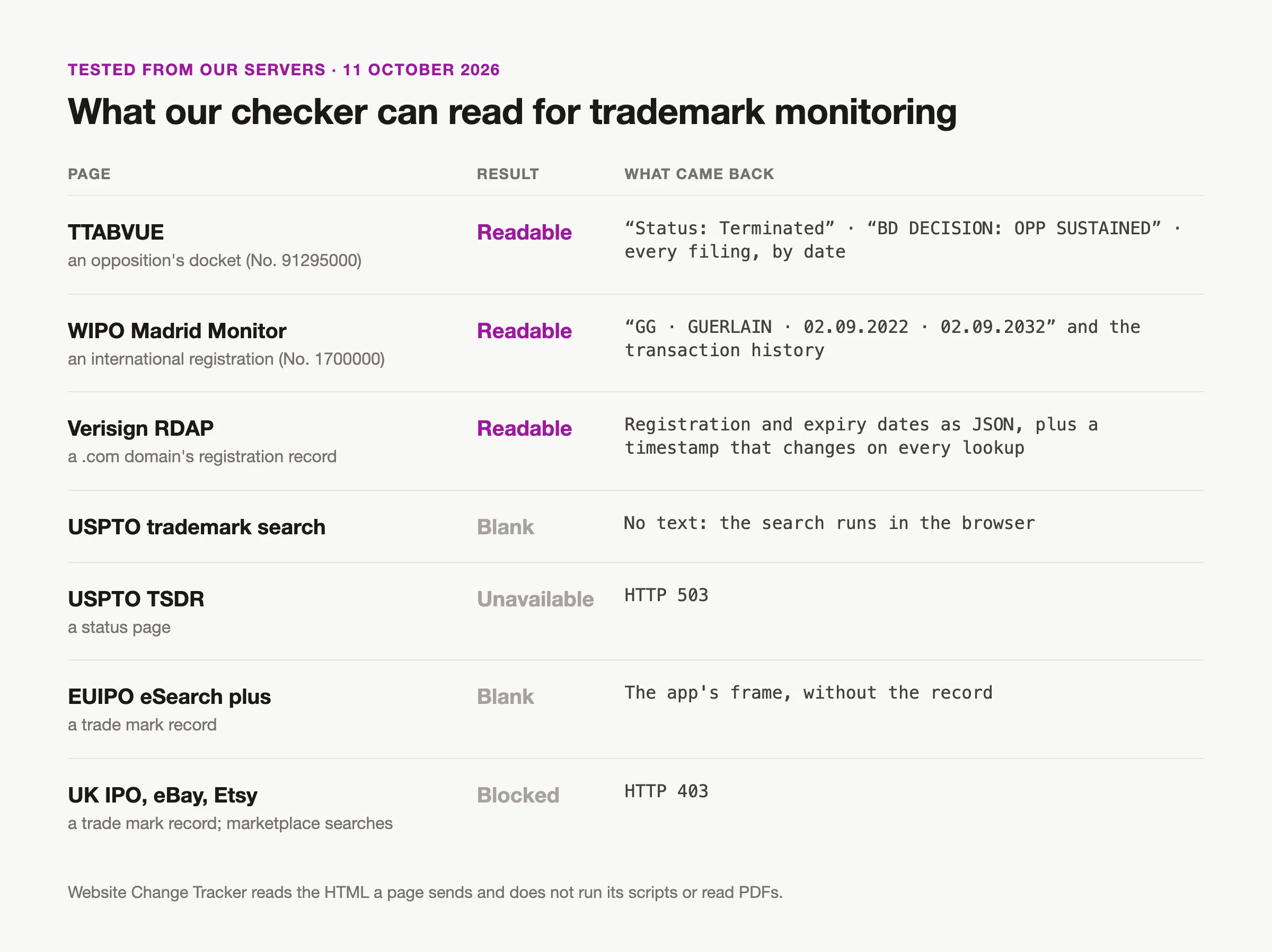
A .com domain's registration record, the registry's RDAP lookup, came back readable too, but it stamps every lookup with the time, so a monitor would log a change on every check. For lookalike domains, use a domain watch service.
A copycat's website is worth monitoring after a cease-and-desist letter, to see whether the name comes down, as long as the site puts its text in the HTML. eBay's and Etsy's search pages refused our checker.
The USPTO's trademark search, its status system (TSDR), the EUIPO's eSearch plus and a UK IPO case page came back empty or refused our checker. The two searches build their results in the browser, TSDR answered with HTTP 503, and the UK IPO refused the request. For those, use the office tools above and a watch service.
A check that fails sends no alert; the page shows the error in your dashboard instead. If you are a party to a proceeding, your attorney's docket stays the record.
How to monitor a trademark opposition
Whether you are a party or following a dispute over a mark near yours, the TTABVUE docket is where new filings appear. Setting up a monitor takes a few minutes:
- Find the proceeding on TTABVUE and copy its address, which contains ?pno= followed by the eight-digit proceeding number.
- Create an account and add it as a page to monitor.
- Add 'Results as of' as an ignore line. TTABVUE prints the time of each visit on the page, and the ignore line stops that from counting as a change.
- Write a plain-English rule such as 'tell me when the status changes or a new filing appears'.
- Check daily on Basic; board deadlines run in weeks. Send alerts by email, or to your legal team's Slack channel from Starter.
For a Madrid Monitor record, a rule such as 'tell me when a country's status changes or a new transaction is recorded' does the same job. Each alert shows what changed, old and new. Basic keeps 7 days of history, while Starter and above keep it without a time limit, so you have a record of when each change was first seen.
Monitoring trademark infringement online: marketplaces, ads and domains
To monitor trademark violations that never reach a register, go to where they happen. Each channel has its own route:
- Amazon Brand Registry is free, and it requires a pending or registered trademark for your brand name or logo.
- Google Ads takes trademark complaints. Google will 'review it and may restrict use of the trademark' in ads, although it does not restrict using a trademark as a keyword.
- A domain can be challenged under the Uniform Domain-Name Dispute-Resolution Policy (UDRP) if it is identical or confusingly similar to your mark, its holder has no rights or legitimate interests in it, and it was registered and is being used in bad faith. WIPO charges $1,500 for one to five domains decided by a single panelist, and $4,000 with three.
- Brand protection services scan for the name across many sites: Abion sells a marketplace watch as an add-on, and Red Points and BrandShield also file the takedowns for you.
A page monitor fits beside them on the specific pages you already know about, as long as those pages serve their text as HTML. To find new mentions of the name itself, see Google Alerts alternatives. For a rival's pricing, product and careers pages, see how to monitor competitors.
Which plan you need for trademark monitoring
Trademark deadlines run in weeks, so daily checks are enough for everything above. The plans differ in how many pages you can follow and where alerts go:
| Plan | Pages | Good for | Alerts by | Price |
|---|---|---|---|---|
| Basic | 5 | A few opposition dockets or international registrations, checked daily, with 7 days of history | $5 a month | |
| Starter | 50 | A legal team's list, with history kept without a time limit and alerts in Slack | Email, Slack, webhook | $30 a month |
| Pro | 250 | Firms and agencies following cases for several clients | Email, Slack, webhook | $150 a month |
Billed yearly, Basic is $4 a month, Starter $24 and Pro $120. Website Change Tracker is not a trademark watch service: use it beside one, or beside the free office alerts. For patents, see patent monitoring, and for other pages legal and marketing teams monitor, see website monitoring for business. Every plan is on the pricing page.
Sources
- USPTO: warning about trademark monitoring and document filing companies (2012)
- 15 U.S.C. 1052: refusal of confusingly similar marks, Section 2(d)
- USPTO: trademark applications filed in fiscal 2025 (December 2025)
- Debevoise & Plimpton: Trademark monitoring, an ounce of prevention (November 2025)
- 15 U.S.C. 1064: cancellation of registration
- USPTO: Trademark Official Gazette
- 15 U.S.C. 1063: opposition
- 37 CFR 2.102: extensions of time to oppose
- 37 CFR 2.149: letters of protest
- USPTO: letter of protest practice tip
- USPTO fee schedule
- USPTO: trademark fee changes take effect 18 January 2025
- EU trade mark regulation (EU) 2017/1001, Articles 43 and 46
- UK IPO: guidance on standard opposition proceedings
- UK IPO: earlier rights fact sheet
- USPTO: TTAB figures for fiscal 2025 (January 2026)
- Corsearch: trademark watching
- Corsearch: TrademarkNow
- Clarivate CompuMark: trademark monitoring
- Abion: trademark watch
- Alt Legal: what is a trademark watch service (April 2024)
- LegalZoom: trademark monitoring
- Trademarkia: filing plans
- Trademark Engine: trademark monitoring
- Red Points: pricing
- BrandShield
- USPTO: online tools for trademarks (MyUSPTO)
- USPTO: docket email alerts for status changes
- USPTO: retiring TESS (October 2023)
- WIPO: finding and monitoring international trademark registrations
- WIPO: Madrid Monitor email alerts (2018)
- WIPO: watch competitors' marks in Madrid Monitor (2016)
- USPTO: recognizing common scams
- USPTO: examples of fraudulent or misleading solicitations
- USPTO: the 'Trademark Safeguard' solicitation (PDF)
- TTABVUE: Opposition No. 91295000
- WIPO Madrid Monitor: international registration 1700000
- Verisign RDAP service for .com
- Amazon Brand Registry
- Google Ads: trademarks policy
- WIPO: guide to the UDRP
- WIPO: UDRP fees