Patent monitoring: alerts for competitor patents, new filings and legal status
Patent monitoring compared: free EPO and WIPO alerts, paid services from Derwent to PatSnap, and the 9-month windows to challenge a newly granted patent.
 Alexandra SwanCustomer Operations Lead
The short answer
Patent monitoring means getting told when the patents that matter to you change: a competitor's application is published or granted, a patent you follow changes owner or lapses, or a window to challenge one opens. The EPO's Register Alert emails you about events on up to 5,000 European files for free, and WIPO PATENTSCOPE turns a saved search into an RSS feed. Google Patents has no alerts. Paid services such as Derwent, Questel Orbit and PatBase add legal-status alerts across many offices, plus analysis. Website Change Tracker watches pages you name, such as a patent's Google Patents page, through a CSS selector on Starter, or a competitor's patent marking page.
What patent monitoring covers
A record 3.7 million patent applications were filed worldwide in 2024, according to WIPO, and the European Patent Office received over 200,000 in 2025. Patent monitoring narrows that down to the filings and patents that can affect you, and it splits into four jobs:
| Job | What you hear about | Why it matters |
|---|---|---|
| Competitor watch | New applications and grants from the companies you name | Shows what a rival filed, once the application publishes about 18 months later |
| Technology watch | New filings in a field, by keyword or patent classification | Prior art for your own filings, and early warning of patents you may have to design around |
| Legal status watch | Grant, reassignment, lapse and expiry of specific patents | A blocking patent whose maintenance fee goes unpaid expires early |
| Challenge windows | Publications and grants that start a deadline for third parties | Oppositions, post-grant reviews and prior-art submissions each close on a deadline |
A patent watch service, in the industry's sense, usually means the first two: a saved search, run on a schedule, with the new hits sent to you or your patent attorney. The third and fourth concern patents you already know, which is where the EPO's Register Alert and page monitoring fit best. For the rest of a rival's public footprint, see how to monitor competitors.
When patent information changes, and the deadlines it starts
Patent offices publish on a fixed weekly rhythm, and most of the deadlines a watch protects are counted from those dates:
| Event | When | What it starts |
|---|---|---|
| US applications published | Thursdays, about 18 months after the earliest filing date | A window to send the examiner prior art. It closes when the application is allowed or, if sooner, at the later of 6 months after publication and the first rejection |
| US patents granted | Tuesdays, listed in that week's Official Gazette | Post-grant review within 9 months of grant; inter partes review after that |
| European patents granted | Mentioned in the European Patent Bulletin, every Wednesday | Opposition within 9 months of the mention of grant |
| US maintenance fees due | 3.5, 7.5 and 11.5 years after grant, with a 6-month grace period at a surcharge | If still unpaid, the patent expires at the end of the grace period |
| Patent term ends | 20 years from the US filing date, or from the earliest non-provisional US application it claims, plus any term adjustment | Expiry |
Maintenance fees apply to utility patents, not design or plant patents. At the USPTO's large-entity rates the three payments are $2,150, $4,040 and $8,280, and the owner decides at each one whether a patent is still worth keeping. A lapse is not always final. The USPTO can accept a late payment if the delay was unintentional, which restores the patent, so check the USPTO's record before acting on one.
These deadlines are summaries of the statutes linked below, not legal advice. Confirm any deadline for a specific patent with a patent attorney.
Because of that weekly rhythm, coverage matters more than speed in patent monitoring. Missing a publication can cost you a window that does not reopen, and hearing about it a day later costs nothing.
Free patent alerts compared
You can cover part of patent monitoring without paying, if you know which tool does what. Checked on 11 October 2026:
| Tool | What it alerts on | What you need |
|---|---|---|
| EPO Register Alert | Register events on the European applications and patents you pick, by email once the EPO records them. Up to 5,000 files per account. A few events, including changes in file status, do not send a notification | A Register Alert account; the Register is a free service |
| WIPO PATENTSCOPE | An RSS feed of new results for a saved search | A WIPO account, with the search saved as not private |
| The Lens | New results for a saved patent search, run weekly | A free account for personal, non-commercial use; companies need a commercial licence |
| Espacenet | No alerts that the EPO documents. 'My patents' saves a list of documents | No account needed to search |
| Google Patents | No alerts. Its help pages describe no alerts or saved searches; you can download up to 1,000 results as a CSV | No account needed |
| USPTO Patent Public Search | No alerts, and workspaces cannot be saved; they time out after 30 minutes of inactivity | A USPTO account from 7 November 2026 |
| USPTO Patent Center | Emails about new Office communications, only for applications under your own customer number | Your own filings |
A saved search in PATENTSCOPE, or in The Lens with a commercial licence, covers much of competitor and technology watching, and Register Alert covers the European files you already follow. What the free tools do not give you is alerts on legal status across many offices, or analysis of what a new filing means.
Patent monitoring software and services compared
Nearly all paid patent monitoring services are sold by quote. This is what each vendor says about its monitoring on its own pages:
| Service | What it monitors | How often | Price |
|---|---|---|---|
| Clarivate Derwent | Derwent Patent Monitor, launched in November 2025, uses AI to evaluate potential threats for freedom to operate and opposition work. Derwent Innovation emails you when a record you watch changes | A weekly digest for watched records | On request |
| PatSnap | Its Premium patent edition lets you monitor, compare and review documents | 'In real time', in PatSnap's words | Patent editions on request; its Eureka AI assistant is free at Basic and $100 a month at Pro |
| Questel Orbit Intelligence | Legal Status Monitor, an optional module, compares each register between runs, across INPADOC and nine registers including the US, European, Chinese and Japanese ones | From 'bi-weekly' to every six months | On request |
| PatSeer | Legal status updates and forward citations on the records you choose | Weekly or monthly | On request |
| Minesoft PatBase | INPADOC legal status, US prosecution status, and a notice when someone cites your patents | Not stated | On request |
| MaxVal Max-Alerts | Patent publication alerts by email or into a hosted database | Weekly, 'bi-weekly', monthly or quarterly | Estimated from search volume and frequency |
| IP.com InnovationQ+ | Search alerts, and competitor tracking across corporate families using S&P Global data | Daily, weekly or monthly | Not published |
| predori | Monitoring extensions to its AI patent search | Not stated | Pay per use, with a 7-day free trial |
| LexisNexis | Automated alerts in TotalPatent One, per its 2022 product flyer, beside PatentSight+ analytics | Not stated | Not published |
Choose by the job. For competitor and technology watching, the platforms (Derwent, PatSnap, Orbit, PatBase, PatSeer) run the searches and collect the hits in one place. For legal status on a fixed list of patents, Orbit's Legal Status Monitor, PatSeer and Derwent's watched records are built for it. If you need a person to triage the hits, ask whether a service includes analysts or only software.
Monitor a competitor's key patents with Website Change Tracker
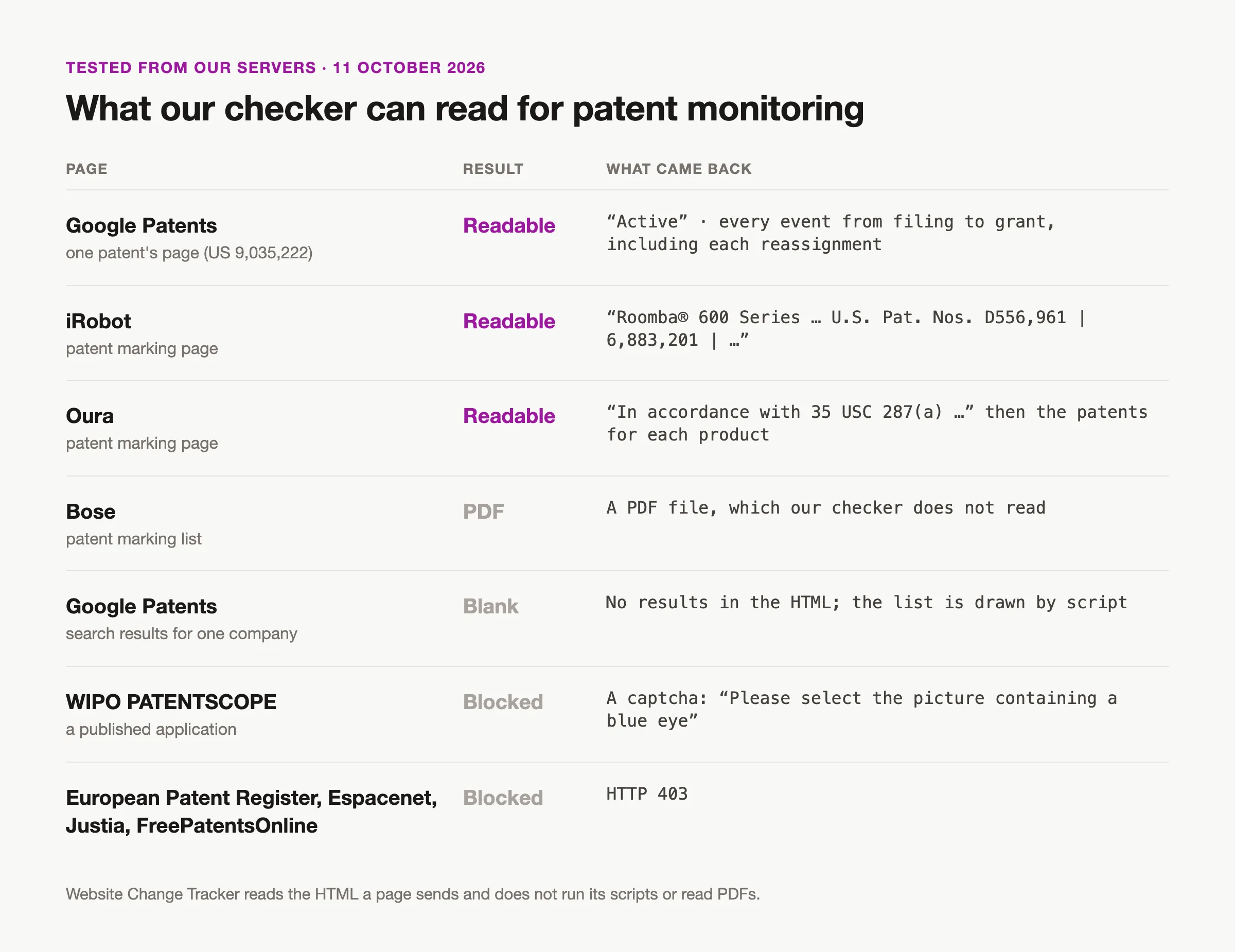
Page monitors do not search patent databases; saved searches and paid services do. Website Change Tracker watches pages you name and tells you what changed on them. We tested patent pages from our own servers on 11 October 2026, and the one that works best is a patent's own page on Google Patents.
A US patent's page on Google Patents shows its legal status, such as 'Active', and a timeline of events, including filing, publication, grant, reassignments and the anticipated expiration. On Ember's US patent 9,035,222, the timeline lists the assignment to Piatto Technologies in 2014. It then lists a transfer to Oromo Technologies in 2015, and Oromo's change of name to Ember Technologies that year. An expired patent says so: US 6,883,201 reads 'Expired - Lifetime, expires 2023-05-23'.
Google labels the status 'an assumption and is not a legal conclusion', so treat an alert as a reason to check the office record. Other patent sources did not work. Google Patents search results, the EPO Register, Espacenet, Justia and FreePatentsOnline came back empty or refused our checker, and PATENTSCOPE answered with a captcha. For new filings, use a saved search in PATENTSCOPE or a paid service.
- Open the patent on Google Patents and copy its address, such as patents.google.com/patent/US9035222B2/en.
- Create an account on Starter or above, which adds CSS selectors, and add the address as a page to monitor.
- Point a CSS selector at the status and the timeline: dd[itemprop="legalStatusIfi"], dd[itemprop="events"]. A whole Google Patents page can run to about a million characters, as US 9,035,222 does, which is more than our checker keeps for one page. The selector cut that patent to about 5,000.
- Add a plain-English rule such as 'tell me when the legal status changes, the patent is reassigned, or a new event is added'.
- Leave the check at daily. Patent events are published weekly, so hourly checks gain nothing.
When a check fails
Failed checks send no alert. If Google Patents refuses a request, or renames the fields the selector points at, the page shows the error in your dashboard instead. Look at its status now and then. For any patent with a deadline attached, also follow it in Register Alert if it is European, or in a paid legal-status monitor.
Monitor competitors' virtual patent marking pages
Since the America Invents Act was signed on 16 September 2011, a patent owner can mark a product with 'patent' or 'pat.' and a web address instead of the patent numbers. The page has to be one that 'associates the patented article with the number of the patent'. Marking matters to the owner: without it, damages for infringement only run from when the infringer was notified. A 2014 USPTO report found that virtual marking had 'likely met its intended objectives'.
Many companies that sell hardware keep marking pages, and update them as patents are granted and products launch. A change to a rival's list is a dated signal: a new patent on a product you compete with, a new product, or a patent they have stopped claiming. Read removals carefully, though. Marking a product with an expired patent that covered it is not false marking, so some lists keep old numbers. iRobot's Roomba 600 entry still includes U.S. Pat. No. 6,883,201, which Google Patents lists as expired in 2023.
We tried patent pages at 21 companies from our servers on 11 October 2026:
- Eleven came back usable. Ten list their patents as text: Abbott (diabetes products), Ember, iRobot, Milwaukee Tool, Oura, Peloton, Sonos, Therabody, Traeger and Vitamix. Peloton's says 'This page shall serve as notice under 35 U.S.C. § 287(a)' above the patents for each product. The eleventh, Logitech, lists each version of its PDF by date, such as 'Logitech Patent List - December 1, 2025', so a monitor on the page tells you when a new list goes up.
- Four keep the list in a PDF, which our checker does not read. Medtronic's patents address redirects to a PDF, and Bose's list is a PDF. Boston Scientific and Stanley Black & Decker link to one without a date in the link text, so a new version would not show up as a change.
- Six refused our checker outright.
Monitor a marking page with a rule such as 'tell me when a patent is added or removed for any product'. Logitech has posted four versions of its list since April 2020, so daily checks on Basic are plenty.
Which plan do you need for patent monitoring?
Patent events are published weekly, so check frequency matters less than how many pages you follow, whether you need a selector, and where the alert goes:
| Plan | Pages | Good for | Alerts by | Price |
|---|---|---|---|---|
| Basic | 5 | A handful of competitor marking pages, checked daily, with 7 days of history | $5 a month | |
| Starter | 50 | Google Patents pages for the patents you follow, each read through a CSS selector, plus marking pages, with history kept without a time limit | Email, Slack, webhook | $30 a month |
| Pro | 250 | Patents and marking pages across several product lines | Email, Slack, webhook | $150 a month |
Billed yearly, Basic is $4 a month, Starter $24 and Pro $120. Use a saved search or a paid service to find new filings, Register Alert for the European files you follow, and Website Change Tracker for the specific patents and marking pages you already know matter. For trademarks, see trademark monitoring. Every plan is on the pricing page.
Sources
- WIPO: record 3.7 million patent applications filed in 2024 (November 2025)
- EPO: record number of patent applications in 2025 (March 2026)
- 35 U.S.C. 122: publication of applications and preissuance submissions
- MPEP 1120: publication on Thursdays
- MPEP 1306: patents issue on Tuesdays
- USPTO: Official Gazette for Patents
- 35 U.S.C. 321: post-grant review
- 35 U.S.C. 311: inter partes review
- European Patent Convention, Article 99: opposition
- EPO: European Patent Bulletin, published every Wednesday
- 35 U.S.C. 41: maintenance fees
- 37 CFR 1.362: time for payment of maintenance fees
- 37 CFR 1.378: accepting a delayed maintenance fee
- USPTO fee schedule
- 35 U.S.C. 154: patent term
- European Patent Convention, Article 86: renewal fees to the EPO end at grant
- European Patent Convention, Article 141: renewal fees for European patents
- EPO: monitoring services in the European Patent Register (August 2024)
- EPO: Register Alert limits
- EPO: Register events and notifications
- EPO: Espacenet release notes
- WIPO PATENTSCOPE: RSS feeds from saved queries (May 2022)
- The Lens: saved queries
- The Lens: release 9.2, weekly patent alerts (July 2024)
- The Lens: terms of use and commercial licences
- Google Patents help: search results page
- USPTO: Patent Public Search frequently asked questions
- USPTO: Patent Public Search, sign-in required from 7 November 2026
- USPTO: e-Office Action notifications
- Clarivate: Derwent Patent Monitor launch (November 2025)
- Clarivate: Derwent legal status monitoring
- PatSnap pricing
- Questel: Orbit Intelligence Legal Status Monitor
- PatSeer: patent alerts and monitoring
- PatSeer pricing
- Minesoft: trackers
- MaxVal: Max-Alerts
- IP.com: InnovationQ+
- predori: prices and licences
- LexisNexis IP
- LexisNexis TotalPatent One product flyer (2022)
- Google Patents: US 9,035,222
- Google Patents: US 6,883,201
- 35 U.S.C. 287: marking and notice
- USPTO: report on virtual marking (September 2014)
- 35 U.S.C. 292: false marking
- Abbott: diabetes care patents
- Ember: patents
- iRobot: United States patents
- Milwaukee Tool: patents
- Oura: intellectual property notice
- Peloton: patents
- Sonos: patents
- Therabody: patents and design registrations
- Traeger: patents
- Vitamix: patents
- Logitech: virtual patent marking
- Medtronic: patents (a PDF)
- Bose: patent marking (a PDF)
- Boston Scientific: virtual patent marking
- Stanley Black & Decker: patents