Get FAA ground stop alerts and ATC delay notifications
Get FAA ground stop and ground delay program alerts for the airports you name, by text, WhatsApp, email or Slack, checked hourly or every 5 minutes.
 Alexandra SwanCustomer Operations Lead
The short answer
To get FAA ground stop alerts, monitor the FAA Command Center's operations plan with a rule that names your airports, such as 'tell me when a ground stop or ground delay program is active or possible at EWR, JFK or LGA'. Website Change Tracker checks it hourly on Starter ($30 a month) or every 5 minutes on Pro ($150), and sends the matching lines by text message, WhatsApp, email, Slack or webhook. FAA NAS Status shows ground stops but does not send alerts.
How to get FAA ground stop alerts for your airports
The FAA posts every ground stop, ground delay program and planned restriction in plain text at fly.faa.gov. Monitoring that page is the most direct way to hear about one: the alert quotes the FAA's own wording, not a summary of it.
- Create an account and add https://www.fly.faa.gov/adv/adv_spt, the Command Center's current operations plan, as a page to monitor.
- Write a rule naming your airports, for example 'tell me when a ground stop or ground delay program is active or possible at EWR, JFK or LGA'.
- Set checks to hourly. The plan is reissued about every two hours, so hourly catches each new version.
- On Pro, also add https://www.fly.faa.gov/adv/advADB, the most recent advisory, checked every 5 minutes, for ground stops within minutes of the FAA posting them.
- Choose where the website change alert goes: a text message or WhatsApp for whoever is on duty, email, a Slack channel, or a webhook into your dispatch or operations system.
One monitored page covers every airport the Command Center is managing, so adding airports means editing the rule, not buying more pages. Starter's 50 pages leave plenty of room for the other pages your operation depends on.
What a ground stop alert tells you
The operations plan carries more than the programs in effect. Three of its sections are worth a rule:
- TERMINAL ACTIVE: programs in effect now. At 19:30 UTC on 7 October 2026 it read 'UNTIL 2359 -AUS GROUND DELAY PROGRAM'.
- TERMINAL PLANNED: the early warning. 'UNTIL 0000 -MCO/TPA GROUND STOP POSSIBLE' flagged a possible stop at Orlando and Tampa for the rest of the evening.
- STAFFING TRIGGER(S): facilities with a staffing shortfall and the window it covers, with a note on the restrictions to expect.
The rule is what makes the alert readable. Every reissue rewrites most of the plan: between the 17:28 and 19:30 UTC plans on 7 October 2026, 31 lines were removed and 33 added, from the summary paragraph to rocket launch windows. For someone watching Austin, one of those 64 lines mattered, and a plain-English rule is what sends that one and holds back the rest.
Each alert shows the lines that were added and removed, so you read the FAA's exact wording, times included. Every version of the plan stays in the page's history with its timestamp, which gives you a dated record of what the FAA had announced when a flight was held, for a post-flight review or a customer who asks why.
Which plan you need for ground stop alerts
Check frequency decides how quickly you hear. Ground stops are measured in minutes, so the daily checks on Basic are too slow for them.
| Plan | Checks | What it catches | Alerts by | Price |
|---|---|---|---|---|
| Basic | Daily | Runway closures and other slow-moving notices, not ground stops | $5 a month | |
| Starter | Hourly | Each operations plan reissue, about every two hours. A short stop can start and end between two plans | Text, WhatsApp, email, Slack, webhook | $30 a month |
| Pro | Every 5 minutes | The plan plus the most recent advisory, within minutes | Text, WhatsApp, email, Slack, webhook | $150 a month |
Billed yearly, Starter is $24 a month and Pro $120. No alert can beat the FAA's own publishing, either: Austin's ground stop on 7 October 2026 took effect at 17:22 UTC and its advisory went out at 17:33. See pricing for every plan.
Ground stop alert options compared
Website Change Tracker is not the only way to hear about ground stops. These are the options and what each one sends:
| Option | What you get | How often | Cost | Best for |
|---|---|---|---|---|
| FAA NAS Status | A live map and list of ground stops, delay programs and closures. No notifications. | When you look | Free | Checking an airport by hand |
| NBAA Air Traffic Services alerts | Emails on upcoming TFRs and airspace and airport issues that may affect business aircraft | When NBAA sends them | NBAA membership | Business aviation operators |
| FlightQueue | A daily email digest of ground stops, delay programs and delays at major US airports; premium adds faster alerts and push notifications | Daily free; every 10 to 20 minutes on premium | Free, or a paid premium plan | Travelers watching the airports they use |
| Airline apps and flight trackers | The status of one flight: delays, new departure times, gate changes | As the airline updates it | Usually free | Your own flight |
| Website Change Tracker | The FAA's own advisory text for the airports your rule names, with a dated history of every version | Hourly or every 5 minutes | From $30 a month | Operations teams that want alerts by text, WhatsApp, Slack or in their own systems |
If a once-a-day summary is enough, FlightQueue's free digest covers it, and NBAA members already have their association's alerts. We fit when the alert has to reach a phone, Slack or another system, should name only your airports, and needs to leave a record.
Why not monitor NAS Status itself? Its web page needs JavaScript to show anything, and Website Change Tracker reads pages as the server sends them, without running scripts. Its XML feed (nasstatus.faa.gov/api/airport-status-information) is built for software and stamps the time on every request, so a page monitor would see a change on every check. If you write code, poll that feed directly.
Ground stops, ground delay programs and other ATC delays
ATC delays come from the FAA's Air Traffic Control System Command Center in Warrenton, Virginia, which balances demand against capacity for up to 50,000 flights a day. They add up: in July 2026, the Bureau of Transportation Statistics counted 6.90% of flights by the reporting US airlines as delayed by the National Aviation System, the cause that covers air traffic control. The programs an alert will name:
| Program | What the FAA does | What it means for a flight |
|---|---|---|
| Ground stop (GS) | Holds flights bound for an airport or area at their departure airports until the stop ends. | No departure until the stop lifts or is extended. The FAA says ground stops normally come with little or no warning. |
| Ground delay program (GDP) | Spreads arrivals into an airport over hours by giving each inbound flight an arrival slot. | A later departure time, called an EDCT, which the flight should not leave before. |
| Airspace flow program (AFP) | Assigns departure times to flights crossing a constrained piece of airspace, usually storms en route. | Like a GDP, but set by where you fly through rather than where you land. |
The FAA uses a ground stop when demand will exceed what an airport can accept for a short time, or to buy time while it sets up something longer, such as a ground delay program. A ground delay program covers a lengthy shortfall, most often caused by low ceilings and poor visibility. An EDCT, or expect departure clearance time, is the runway release time the FAA assigns a flight in one of these programs.
A ground stop as it happened: Austin, 7 October 2026
On 7 October 2026, taxiway construction at Austin-Bergstrom turned into a ground stop, then a ground delay program, in under an hour. These are the Command Center's advisories as they went out, in UTC; Austin was five hours behind.
| Sent (UTC) | Advisory | What it said |
|---|---|---|
| 15:26 | AUS airport arrival delays | Arrival delays and airborne holding of up to 30 minutes, 'due to compacted demand'. |
| 17:33 | Ground stop | Flights to Austin from seven en route centers held on the ground from 17:22 to 18:45. Cause: taxiway construction. 'Expect GDP to exit ground stop.' |
| 18:03 | Ground stop, revised | Kansas City Center added to the stop. |
| 18:16 | Proposed ground delay program | Anticipated average delay 44 minutes, maximum 144. |
| 18:32 | Ground delay program | Ground stop cancelled and flights released on EDCTs. Average delay 50 minutes, maximum 147, for arrivals until 23:59. |
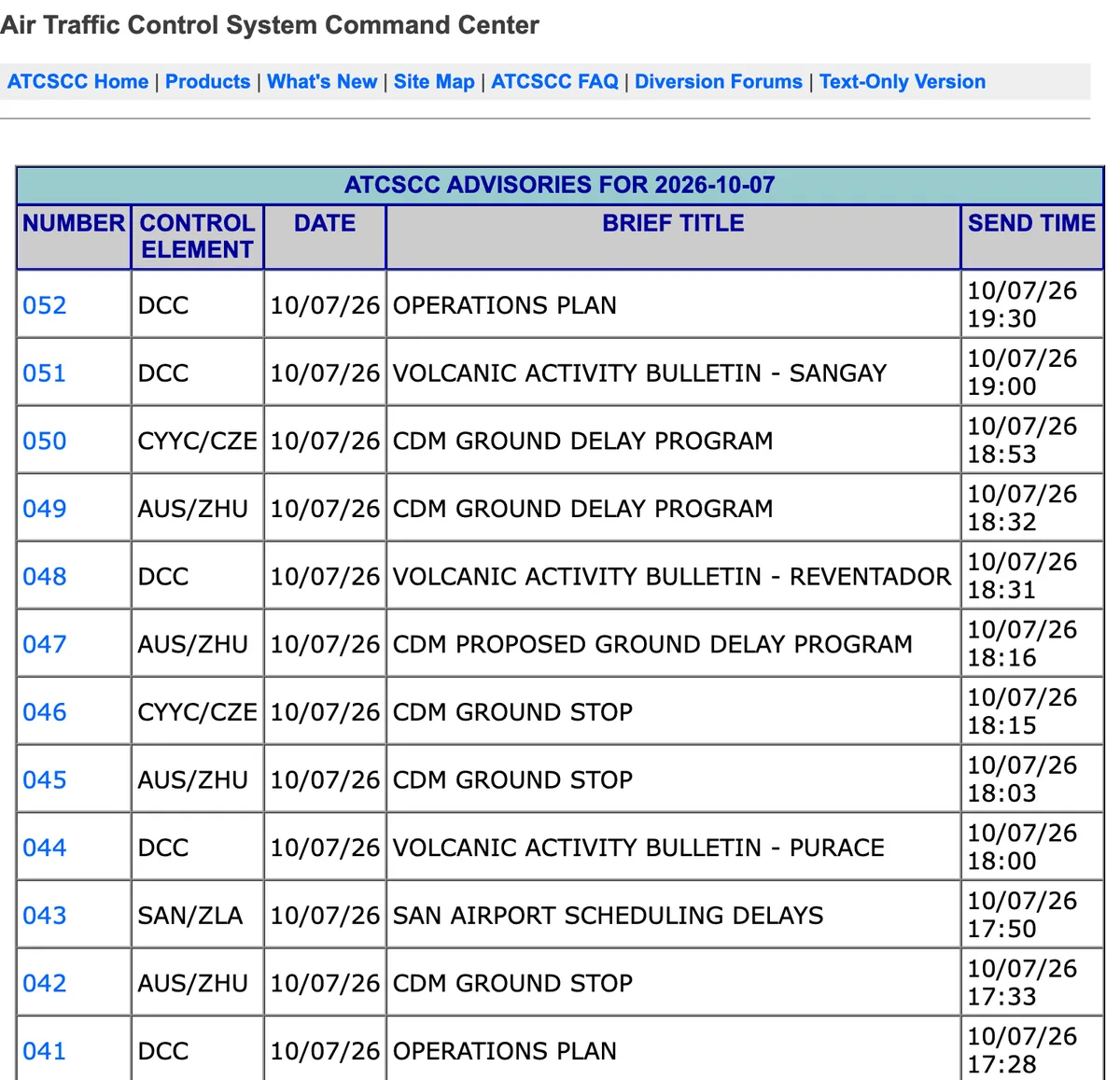
The whole sequence fit inside one hour, which is why check frequency matters. Checked every 5 minutes, the most recent advisory page showed the ground stop within minutes of 17:33. Checked hourly, the operations plan showed the ground delay program at 19:30 UTC, but the stop itself started and ended between two plans and never appeared in one. A daily check would have caught, at most, the end state.
Sources
- FAA: Air Traffic Control System Command Center (ATCSCC)
- FAA Pilot/Controller Glossary: ground delay program, ground stop
- FAA Pilot/Controller Glossary: airspace flow program
- FAA Pilot/Controller Glossary: expect departure clearance time (EDCT)
- FAA ATCSCC: ground stop and ground delay program overviews
- FAA ATCSCC: current operations plan
- FAA ATCSCC: advisories database
- FAA ATCSCC advisory 042, 7 October 2026: AUS ground stop
- FAA ATCSCC advisory 049, 7 October 2026: AUS ground delay program
- FAA: National Airspace System Status
- FAA: NAS Status user guide (version 2.2.1)
- NBAA: Airspace/Airport Alerts
- FlightQueue: FAA delays and alerts
- Bureau of Transportation Statistics: on-time performance and delay causes